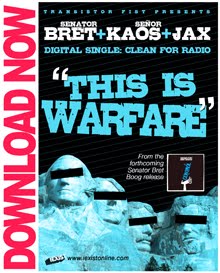
Thursday, October 21, 2010

Monday, August 30, 2010
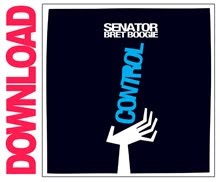
CONTROL IS NOW AVAILABLE
 My new album is now available for FREE for a limited time as a hard copy CD and full digital download.
DOWNLOAD AT
http://www.iexistonline.com/
or
http://www.transistorfist.bandcamp.com/
This is an early heads up. More info to follow.
Monday, August 16, 2010
GET LIT: Hip-Hop and Philosophy

Hip Hop and Philosophy (Rhyme 2 Reason)
Edited by Derrick Darby and Tommie Shelby, 2005
This loose philosophy collection illustrates how hip-hop has wholly influenced American culture. Authors, screenwriters and visual artists have created a multitude of works the last few years from an unyielding hip-hop perspective. This book shows its impact on academia.
Edited by Derrick Darby and Tommie Shelby, 2005
This loose philosophy collection illustrates how hip-hop has wholly influenced American culture. Authors, screenwriters and visual artists have created a multitude of works the last few years from an unyielding hip-hop perspective. This book shows its impact on academia.
Blossoming from hip-hop’s Golden Era, “Hip Hop and Philosophy” shows the impact that artists like KRS-ONE and Chuck D had on a generation of today’s educators and thinkers. The affected use the empowerment handed to them by the culture’s forbearers to influence public policy, ethics, law and thought.
The book compiles 17 essays by the country’s top young philosophy professors. The writers have written key works on race, human rights and philosophy, but here they focus on how hip-hop relates to ancient ideas and philosophical constructs.
Major works like this show how interwoven hip-hop is with contemporary ideology, but can also demean the culture by narrowing it into a particular style as opposed to an underlying understanding of things. These philosophers grew up with the culture and don’t necessarily differentiate between what is hip-hop and what is not. But why does the cover have to use a graffiti piece and wack “tag” fonts to sell itself as hip-hop? Why do the editors write in slang to prove their credibility? Are these compulsory tenants of hip-hop, or has hip-hop grown beyond its stylistic margins?
Wait. I’m thinking too much, but that’s what philosophy is supposed to do. And in that respect, “Hip Hop and Philosophy” succeeds. The kids that used to watch park jams from their mom’s fifth-floor window and the b-boys that ironed their Lees into crisp tendrils draped above suede Clydes are now piloting all kinds endeavors.
Sadly, though, the essays are too similar in reference. While each writer has a distinct theme, they all seem to use the same elements as a basis for their arguments, like hip-hop ended with BDP’s final demise around the time of their graduations. The book is filled with Chuck D-isms, NWA references and Poor Righteous Teachers righteousness alongside a bit of “back-in-the-day” tenderness. That Golden Era revelry sits with contemporary references as blasé as Nelly and Jay-Z.
In the end, the book lacks hip-hop’s contemporary contributions. Though the writers perform exceptionally, I feel their comments would benefit from a few nights at an underground hip-hop event.
-Bret Duchen
Wednesday, August 4, 2010
GET LIT: THE LAST POETS

On A Mission (Selected Poems and A History of The Last Poets)
Abiodun Oyewole and Umar Bin Hassan with Kim Green, 1996
The Last Poets’ relative obscurity reflects issues plaguing the group throughout its storied career. The realities of being an honest-to-goodness revolutionary and the trappings of inner-city life hindered the group’s evolution, but created compelling drama and cultural relevancy.
Abiodun Oyewole and Umar Bin Hassan with Kim Green, 1996
The Last Poets’ relative obscurity reflects issues plaguing the group throughout its storied career. The realities of being an honest-to-goodness revolutionary and the trappings of inner-city life hindered the group’s evolution, but created compelling drama and cultural relevancy.
“On A Mission” sums up the group’s story through the candid recollection of its most vital members, Abiodun Oyewole and Umar Bin Hassan. The book also collects 30 poems. The works are best heard and not read. They have a more traditional appeal when printed. Though tremendously forceful and persuasive, the poems do not seem as good without the fiery delivery of its author. The Last Poets helped create the spoken word genre, but seem undeveloped when compared to more proficient written poetry.
Predecessors to rap, The Last Poets took the black oral tradition to new heights in expressing minority plight. Springing from Harlem’s black power movement, the poets used their voices to shout against, and antagonize, the establishment.
“Since Harlem was the mecca of African-American political and cultural events, many of us assumed the revolution would start there and spread like wildfire. Being one of The Last Poets made me feel like I was at the vanguard of making this revolution happen,” reflects Oyewole.
The group of three poets and a drummer was born in 1968 at a birthday celebration for Malcolm X. They quickly garnered a following due to their guttural honesty and emotive performances. The Last Poets became instant legends with the release of their first record. They created the revolutionary black poet stereotype so often parodied. Draped in dashikis and ranting about “the man,” the group stated what America needed to hear, while creating an ethnic intrigue that still exists today.
After shocking people into consciousness with poems like “Niggers Are Scared of Revolution” and “Run Nigger,” The Last Poets began to fall apart. New members came and went. They were soon afflicted with issues so prevalent in the 1980s. Umar Bin Hassan was even thought to be dead after struggling with drug addiction. He was so adrift that he missed his royalty money after A Tribe Called Quest came calling for sample clearances in the 1990s.
With a resurgence of popularity based on their impact on Golden Era hip-hop, the group reorganized. The mid-1990s saw a new record (hip-hop heavy and even featuring Chuck D) and a slot on the Lollapalooza tour.
-Bret Duchen
Monday, July 19, 2010
GET LIT: FUZZ-ONE, A Bronx Childhood

FUZZ-ONE, A Bronx Childhood
Vincent Fedorchack, 2005
Whether you praise or loath graffiti, this tale of youthful debauchery is an essential document of the city-wide aggression and style that sparked a revolution in visual arts. Forget that; this book is just plain ill.
Vincent Fedorchack, 2005
Whether you praise or loath graffiti, this tale of youthful debauchery is an essential document of the city-wide aggression and style that sparked a revolution in visual arts. Forget that; this book is just plain ill.
Tons of books about graffiti are floating around, but I haven’t seen anything as raw as Fuzz One’s wild 1970s New York City memoir.
The book, filled with crumbling photos of graff’s early days, is the true story of Fuzz’s unsupervised and chaotic childhood spent wandering the subway lay-ups and city streets at all hours. His bombing mission memories are rife with violent intrigue and period details. Fuzz’s escapades through the city are unnerving when realizing he was doing this in his pre-teen years. Not only was he racking paint and getting up, but he was devising marijuana marketing schemes, dodging Satan worshipers, being shot and stabbed all in the quest for fame.
The book starts out safe, with Fuzz retracing his father’s influence and early departure. He relates his memories of hunting and exploring the woods in his rural home with his later desire to delve into the city’s underbelly. His mother soon moved him to the Bronx, where he wandered the streets as a 10-year-old tagger who wrote “Popeye.” He later changed how graffiti flowed through the city with his unabashed bombing etiquette and stoned style.
Throughout the book he pays homage to the originators and his contemporaries, while never sounding nostalgic. He rarely even speaks of himself as a great writer. But make no mistake; he did more for NYC street culture before he was a teenager than most old-schoolers can claim. The book’s nostalgia is one of its main draws. The pre-rap years are rarely told. His tales of inner-city circumnavigation include some amazing history. You will feel at home with his Bronx tales even if you have no idea of the names he cites. He tells of early street gangs with vicious remembrance and recalls fashions that the most ardent B-Boy would be hard pressed to speak of.
This book is not a trite artifact, though. It is a meaningful look into how young lives can spin out of control and how city life can devour a young soul. Many of Fuzz’s friends were killed during their early years due to unsupervised stupidity while cascading through a time bomb of urban decay that later screamed out as HIP-HOP!
-Bret Duchen
Tuesday, July 6, 2010
GET LIT: Notes Of A Native Son

Notes Of A Native Son
James Baldwin, 1955
Noted black intellectual James Baldwin can always be trusted to bring the noise. If you can’t find this little hard-to-come-by gem, just grab any Baldwin book you come across. I’ve read a ton of his work and I’m rarely disappointed.
James Baldwin, 1955
Noted black intellectual James Baldwin can always be trusted to bring the noise. If you can’t find this little hard-to-come-by gem, just grab any Baldwin book you come across. I’ve read a ton of his work and I’m rarely disappointed.
“Notes Of A Native Son,” which references the famous Richard Wright book, is hardcore criticism of a world not eager to coexist with blackness. In 1940 Wright’s defiant novel “Native Son” brought the reality of growing up black in America to a shocked public. That book helped increase racial discourse, and society soon saw a greater representation of black America in film, music, art and literature.
The problems of stereotypes again arose without much criticism. This book, though, seeks to dismantle the new reality the mass media was offering to the American public. Black stories were presented, but were they accurate? Black faces were represented, but were they accurate? Baldwin starts with these basic questions then delves into the American subconscious with subsequent arguments.
In discussing the increased publication of ethnic protest novels, he writes, “They emerge for what they are: a mirror of our confusion, dishonesty, panic, trapped and immobilized in the sunlit prison of the American dream.”
With this statement he not only describes then-contemporary black life, but also the decomposing stability of white America. This prefaces the rise of the coming civil rights movement, and highly critical artistic endeavors by writers like LeRoi Jones (aka Amiri Baraka) and filmmakers like Melvin Van Peebles.
Baldwin’s style bears significance. He is highly educated and worldly, which gives his opinions a rhetorical leaning. In utilizing this heavy-handed style he is able to fake out the mid-century intellectual by sounding colorless. This allows him to make serious social criticisms while seeming very safe. It is transparent when reading today, but it still works.
The book discusses the white reverence for “Uncle Tom’s Cabin,” while destroying its mythology. It later condemns Hollywood’s mis-marketing of black films. The book chronicles Baldwin’s search for identity, a struggle that took him from the streets of Harlem across the globe. Baldwin’s writings travel through Atlanta’s racial divide and later to Paris to discover how blacks are treated outside America.
Baldwin’s theme refers to “Native Son,” but previous reading of that work is not necessary, but of course recommended.
-Bret Duchen
Thursday, July 1, 2010
GETTING THERE...

The new Senator Bret solo project, "CONTROL", is in its final stages. The GoodSon has been busy mixing (the most tedious and un-fun part of making a record). Stay tuned.
Subscribe to:
Posts (Atom)